Yellow Bee: A Whimsical Handwritten Font for Crafters
If you’ve ever spent ten minutes tweaking a label to feel just right—only to delete it and start over—you know how much weight the right font carries in handmade design. Yellow Bee isn’t just another script font. It’s a warm, brush-stroked handwritten typeface with gentle bounce, soft contrast, and that effortless charm that makes customers pause mid-scroll. As a crafter who designs candle labels, wedding welcome boards, printable planner pages, and boutique gift tags, I reached for Yellow Bee the moment I saw it—and haven’t put it down since.
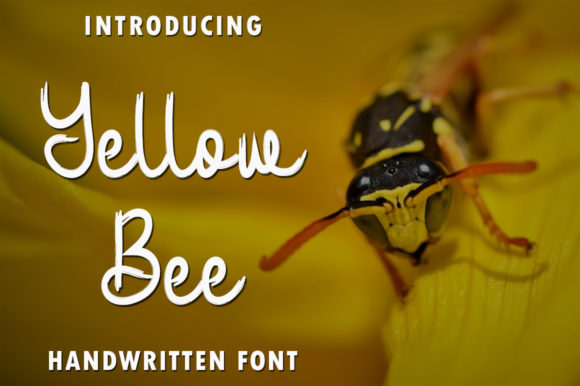
What sets Yellow Bee apart is its balance: whimsical but not childish, expressive but never overwhelming. The strokes have subtle texture—like ink lightly dragged across paper—giving it authenticity without sacrificing crispness on screen or in print. It’s designed as a Script Amp font, meaning it’s built for impact at display sizes, yet remains legible even at 14–16pt when used thoughtfully on product tags or small sticker labels. That duality is rare—and invaluable when your Etsy listing needs to look polished both in a mockup and on a real mason jar lid.
I use Yellow Bee daily across physical and digital products. For candle makers, it adds instant personality to soy wax labels—pairing beautifully with minimalist kraft paper or soft pastel backgrounds. On greeting cards, it brings warmth to birthday wishes and heartfelt thank-yous without competing with illustrations. Wedding stationery? Yes—especially for “Welcome” signs, seating charts, and envelope addressing where elegance meets approachability. And because it’s a true handwritten font, it feels personal, not templated—a subtle signal to buyers that your brand values care and craft.
It shines brightest in short-form applications: names, titles, phrases like “Hand-Poured,” “Small Batch,” or “Made With Love.” I avoid using it for full paragraphs—it’s a display font, not a body font—but that’s exactly what makes it powerful. When paired with a clean sans serif (think Montserrat Light or Poppins Regular), Yellow Bee becomes the visual anchor while the supporting font handles clarity and hierarchy. That pairing works flawlessly on tote bags, SVG cut files for Cricut and Silhouette, and printable wall art meant to hang above a nursery or coffee nook.
For seasonal crafts, Yellow Bee adapts beautifully. Its springlike energy fits Easter egg labels and botanical-themed stickers; its gentle rhythm reads cozy for autumn harvest tags and holiday mug designs. I recently used it for a set of printable farmhouse-style kitchen signs (“Simmer Slowly,” “Bake With Joy”)—the slight irregularity in letter spacing and baseline keeps it feeling hand-lettered, not digital. And because it’s part of the Fonts category designed for commercial creators, it holds up under resizing, tracing, and vector conversion without jagged edges or lost detail.
Readability matters—especially when cutting vinyl or printing tiny stickers. Here’s what I’ve learned: Yellow Bee stays clear down to ~12pt on matte paper labels and 18pt on glossy sticker sheets. For Cricut Design Space or Silhouette Studio, I always convert text to outlines before sending to cut—this preserves the delicate joins and swash details. If you’re using it for product packaging, test print a corner first: the lightest strokes hold well on uncoated cardstock but may thin slightly on high-gloss finishes. Keep line spacing open (1.4–1.6x) in Canva or Illustrator to let the letters breathe—crowding dulls its charm.
The file package includes OTF and TTF formats, plus basic OpenType features like standard ligatures and contextual alternates—enough to add subtle variation between repeated words (great for repeating “Thank You” on a set of gift tags). While it doesn’t include extended multilingual glyphs, it covers English, Western European, and common punctuation needed for most craft businesses. No heavy swashes or decorative flourishes that complicate cutting—just honest, joyful handwriting you can trust.
Font pairing is where Yellow Bee really earns its keep. Try it with a friendly serif like Playfair Display for vintage-inspired wedding invites—or go modern with a geometric sans like Inter for boutique packaging. For digital printables, I often layer it over soft watercolor textures or neutral linen backgrounds; the contrast lets its personality shine without shouting. And because it’s a premium font, it helps elevate your entire brand identity—not just one product, but the consistent voice across your shop banner, Instagram stories, and printed receipts.
Licensing is straightforward—and critical to get right. Yellow Bee includes a commercial license, so you’re fully covered to use it in physical products (candles, mugs, shirts), digital downloads (PDF planners, Canva templates), SVG bundles, client work, and social media graphics. Just remember: you can’t resell the font file itself, embed it in apps, or claim it as your own design. But for every printable, label, sign, or sticker you make and sell? You’re good to go.
At the end of the day, Yellow Bee isn’t about trend-chasing. It’s about finding a typeface that feels like an extension of your hands—the kind that makes your customer smile before they even read the words. Whether you’re hand-lettering a chalkboard menu, designing a Shopify product page, or prepping a batch of holiday gift tags, this script font delivers warmth, professionalism, and quiet confidence. It doesn’t shout. It hums—like a bee in golden light—and somehow, that’s exactly what your handmade brand needs.